
Revisiting the "Crane Brinton Effect" -- in Iran, Venezuela, Syria, Gaza, and the U.S. - Part I
Newsletter 419 -January 28 2026

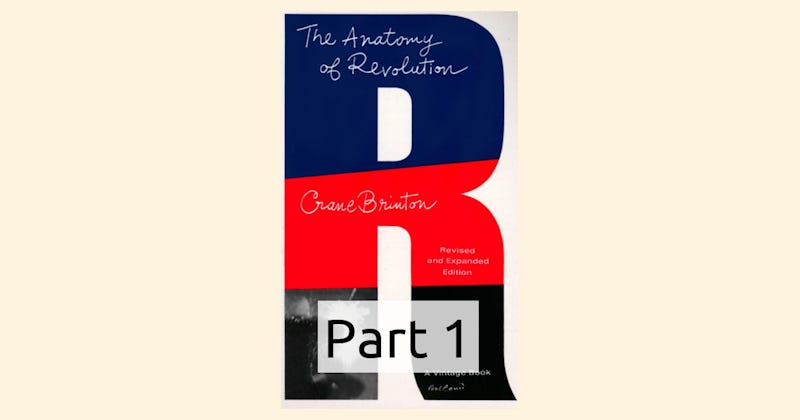

People with good memories who have been reading us for quite some time might remember our 2022 post or even our 2020 post on what we call the "Crane Brinton Effect." Given recent events in Iran and Venezuela, as well as here in the U.S., we thought revisiting Crane Brinton's core idea would help us better understand the turbulent times in which we are now living. (Thanks to New Yorker reporter Robin Wright, who called Guy to talk about Crane Brinton, for making us think about him again.) As seems to happen when we get interested in a topic, our post runs long, so we are splitting this into two parts. In this first part we will review what the Crane Brinton Effect is, and we'll discuss how it does (and doesn't) relate to Iran, Syria, Venezuela, and Gaza. In Part 2, we'll discuss how it relates to the United States and other democracies.
Brinton published a book in 1938 called The Anatomy of Revolution, based on his analysis of the English, American, French and Russian revolutions. His key point was that bringing about a better society after a revolution is much harder than overthrowing the hated regime, and most often fails to happen. Rather, the result of most revolutions is simply the exchange of one oppressive regime for another, often worse, form of tyranny. As we explained in 2020.
The Crane Brinton Effect afflicts countries suffering under the oppressive and corrupt rule of an almost universally-hated regime. It starts when citizens of that country come to the widespread view that they “don’t need to take it anymore.” Since almost everyone hates the regime (often including much of the military and the police), a revolt can quickly garner mass support, leading to a period of optimism and even euphoria with the widespread belief that things really can be changed for the better. Under such circumstances, regimes can quickly collapse — often with minimal violence (since few want to publicly defend the regime.) Since much of society’s executive, legislative, judicial, and even cultural institutions tend to be deeply entangled in the corrupt regime, they, too, are usually overthrown.
The result is a gigantic governance (and cultural) vacuum. Decisions associated with the day-to-day functioning of society have to be made and there are likely to be huge gaps in the institutions and processes that typically make [and carry out] those decisions. This is likely to result in increasingly widespread governance failures and intensifying pressures to “fix things.” But “things” can’t be fixed because the government agencies that used to take care of “things” no longer exist, and nothing has yet been formed to take their place.
The revolutionary factions are also likely to quickly discover that the camaraderie that united them in opposition to the old regime does not extend to their beliefs about what should come next. This is likely to result in intensifying struggles for control among those with differing images of the revolution’s priorities.
These struggles are likely to be severely complicated by the actions of aspiring tyrants who are cleverly and ruthlessly looking for ways in which they can co-opt the power of the revolution and, hopefully, get the deposed tyrant’s old job for themselves. In doing this, they may well be able to recruit support from the so-called “deep state,” which is likely to be looking for a new patron or “front man” willing to leave them in their privileged positions.
Competition between aspiring tyrants and those who would like to see the revolution succeed is almost certain to result in an increasingly intense struggle for social control, resulting in stalemate, chaos, and/or social paralysis.
Without functioning [non-violent] dispute resolution mechanisms (which also don’t exist because the government has been overthrown), disputes are likely to be resolved in favor of those who are most powerful, ruthless, and violent. This is likely to result in an increasingly intense and violent struggle for dominance in which the most ruthless faction ultimately emerges victorious with others suppressed or, sometimes, exterminated in a reign of terror. Ultimately, this is likely to result in a new, comparably (or even more) oppressive, authoritarian regime that exchanges the old elite for a new elite in a way that leaves pretty much everyone else in the same terrible situation that they were in before. (In Brinton’s book this is how the French revolution led to Napoleon and the Russian revolution led to Lenin.)
The only way to escape this fate, we wrote at the time,
... was for proponents of revolutionary change to understand this danger, and firmly commit themselves to some sort of interim governance structure with very strong mechanisms for preventing anyone from using illegitimate, ruthless, and violent tactics to secure dominant positions in the emerging society. The ability to create such mechanisms, in turn, depends upon cultivating a broadly-supported vision for restructuring the society in ways that everyone thinks will do a better job of protecting their interests. But this is seldom in place before the revolution, and is very difficult to develop in time to prevent the Crane Brinton Effect if it is not addressed until after the regime is overthrown.
As we thought again about this already depressing analysis, we realized that we should highlight two related corollaries that make this dismal situation even worse. First, as ruthless, authoritarian regimes become increasingly well-established, it becomes extremely dangerous for citizens to contemplate, learn about, or advocate for alternative systems of democratic governance. Even thinking about how alternatives to tyranny might work is a good way to get yourself (and pretty much anyone else that you care about) killed. This means, when revolutions come, there are going to be very few people who know how to do anything other than fight over whom the next tyrant is going to be.
This is where diaspora, exile communities living abroad in democratic societies can, in theory, play a critical role — if they don’t get so detached from their home country that they lose the ability to be true representatives of the people. These individuals can look to other societies that have struggled (sometimes successfully, sometimes not) to escape the grip of brutal tyrants. They can then adapt lessons from those experiences to their specific circumstances.
A second, even more dismal, corollary is that, in authoritarian societies, there are going to be lots of unscrupulous people who understand and have mastered the skills needed to use brutal force and terror to advance their interests. These are the people who, while they may share the people’s hatred of the existing tyrant, would really like to have his job. And, they are eager to engage in the risky natural selection process that Brinton describes — a process which, in far too many cases, leaves the most cunning, violent, and brutal faction in control.
Bottom line, this is the reason why societies dominated by “I’ll Fight You for It” rules and accompanying concentrations of power and wealth, along with corruption, have so much trouble making a transition to democracy.
Iran, Venezuela, Syria, and Gaza
So, what does all this have to say about the revolutions (and hoped for) revolutions that are in the news as we write this?
In Iran, we are still trying to understand what has happened in a country where virtually all forms of communication and news have been shut down. From the incomplete information that is available, we know that there has been a very large- scale revolt against the regime in virtually all corners of the country. We know that this revolt was, in part, motivated by political opposition to Iran’s theocracy. We also know that much of it has been motivated by the catastrophic collapse of the economy with runaway inflation and acute energy and water shortages. It is also likely that the uprising has, to some unknown degree, been emboldened by President Trump’s abrupt arrest of President Maduro in Venezuela; his Truth Social post, “Iranian Patriots, KEEP PROTESTING - TAKE OVER YOUR INSTITUTIONS!!!... HELP IS ON ITS WAY;” and his promise that if Iran “shoots and violently kills peaceful protesters,” the United States “will come to their rescue,” adding: “We are locked and loaded and ready to go.”
We also know that there has been a brutal crackdown with reports indicating that the government may be willing to sacrifice tens or even hundreds of thousands of its own people to stay in power. At this point, there is reason to fear that the regime has been able to successfully shut down the revolt. It is, however, still quite possible that the government could fall in ways that initiate a Crane Brinton-style struggle over what will come next.
In Syria, the Assad government fell in December 2024 following the defeat of Hezbollah (one of its main supporters) in its war with Israel and a general weakening of Iranian support. From this report, it seems likely that we are now seeing the emergence of another Brinton-style struggle for power there.
In Gaza, some had hoped that there would be a revolt against Hamas following its October 7 attack on Israel and the ruinous war that resulted from that attack (and Hamas’ entrenched tunnel system and civilian shield strategy). Those prospects are diminishing rapidly as Hamas continues to defy efforts to disarm while brutally suppressing the limited opposition that has arisen.
In Venezuela, we have another society afflicted by a terrible and much hated tyrant, Nicolás Maduro — a man who has done much to further the catastrophic collapse of his country. This time, however, the country’s president was not overthrown by his people, but rather removed from power by an outside military force — the United States (in ways that are often compared to the United States’ removal of Saddam Hussein from power in Iraq). However, it doesn’t look like the Trump administration is focused on helping the country make a successful transition to democracy. Instead, he seems to be working with the deep state that surrounded the Maduro regime to exploit the country’s oil reserves.
Still, there are reasons to hope that this is a more promising situation. There will likely be some pressure on Trump to facilitate some sort of democratic transition and the country has much stronger democratic traditions. There is popular opposition to the Maduro regime led by Nobel Peace Prize winner María Corina Machado and Edmundo González Urrutia. Urrutia, with Machado’s backing, is widely regarded as the legitimate winner of the most recent Presidential election — an election that Maduro managed to subvert. Still, making the transition to democracy will only be possible if Machado and Urrutia can overcome opposition from Maduro’s deep state and from the country’s armed militias and criminal cartels, which continue to play by “I’ll Fight You For It Rules.”
The Crane Brinton Effect also applies to the United States and other democracies. We will explain how in Part 2 of this essay.
Please Contribute Your Ideas To This Discussion!
In order to prevent bots, spammers, and other malicious content, we are asking contributors to send their contributions to us directly. If your idea is short, with simple formatting, you can put it directly in the contact box. However, the contact form does not allow attachments. So if you are contributing a longer article, with formatting beyond simple paragraphs, just send us a note using the contact box, and we'll respond via an email to which you can reply with your attachment. This is a bit of a hassle, we know, but it has kept our site (and our inbox) clean. And if you are wondering, we do publish essays that disagree with or are critical of us. We want a robust exchange of views.
About the MBI Newsletters
Two or three times a week, Guy and Heidi Burgess, the BI Directors, share some of our thoughts on political hyper-polarization and related topics. We also share essays from our colleagues and other contributors, and every week or so, we devote one newsletter to annotated links to outside readings that we found particularly useful relating to U.S. hyper-polarization, threats to peace (and actual violence) in other countries, and related topics of interest. Each Newsletter is posted on BI, and sent out by email through Substack to subscribers. You can sign up to receive your copy here and find the latest newsletter here or on our BI Newsletter page, which also provides access to all the past newsletters, going back to 2017.
NOTE! If you signed up for this Newsletter and don't see it in your inbox, it might be going to one of your other emails folder (such as promotions, social, or spam). Check there or search for beyondintractability@substack.com and if you still can't find it, first go to our Substack help page, and if that doesn't help, please contact us.
If you like what you read here, please ....