
Colleague, News, and Opinion Links for the Week of February 1, 2026
Newsletter #421 -February 4, 2025

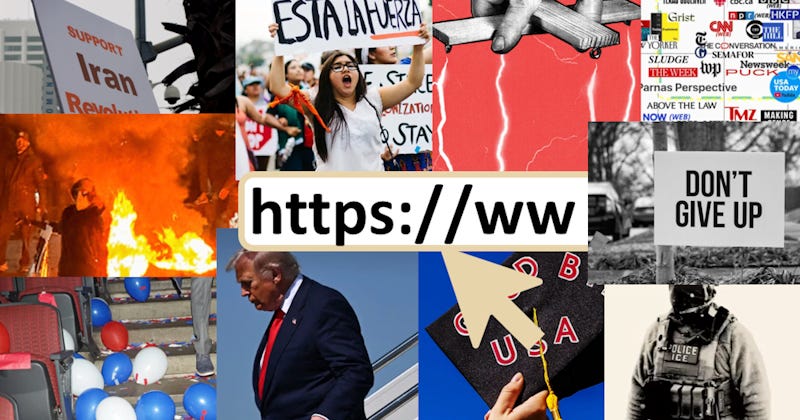

Highlighted Links
A few suggestions about links that we think are especially interesting.
Developing a Unifying Vision
How to Build Political Optimism in Dark Times — A reminder that, for their success, aspiring authoritarians have long relied on instilling a sense of hopelessness and futility among their political opponents.Israel / Hamas War
Attacking Iran is more complicated than most people realize. — It’s one thing to say that Iran’s theocratic rulers should not be able to get away with their astonishingly brutal political crackdown. It’s quite another thing to figure out what to do about it.Israel / Hamas War
The Supreme Leader’s Reckoning — The report on the unspeakable violence being perpetrated against the Iranian people -- violence that is being compared to Srebrenica.Developing a Unifying Vision
Seven Principles for a 21st Century Left — A thought-provoking and, we think, quite promising effort to craft a realistic political vision capable of restoring popular faith in our democracy.US Politics
‘I Wouldn’t Say the Democrats Are in Good Shape’ — A report (with lots of links) on what a series of major new research projects are telling us about the way in which Democrats are viewed by the electorate.Immigration
What a liberal immigration enforcement policy might look like — An effort to get beyond simple condemnation of any and all aspects of Trump’s immigration policies, and articulate what a superior, liberal alternative would look like.US Politics
Has Trump Achieved a Lot Less Than It Seems? — A somewhat reassuring argument that, by focusing on short-term, headline-grabbing actions, Trump is neglecting many of the things required to produce lasting change in the structure of government.

Reader Suggested Links
Highlighting links suggested by our readers. Please send us links to things that you find useful.
Communication Complexity
Ad Fontes Media 2026 Media Bias Chart — A link to the latest media bias chart, a systematic effort to map the political orientation of major publications.Israel / Hamas War
What MAGA Sees in the Minnesota Mirror — A description of the deliberate way in which the conflict over immigration is being systematically escalated (and reflections on where this is taking us).Disinformation
Trump Is Making America Stupider — A report on the way in which the Trump Administration is effectively purging scientists and other skilled workers from both the private and public sectors.Immigration
The powerful tools in ICE’s arsenal to track suspects — and protesters — A detailed exploration of the extraordinary capabilities of U.S. Immigration and Customs Enforcement -- something unprecedented in US law enforcement.Immigration
Top 10 Minnesota Questions — When police violence occurs, the standard advice is an objective inquiry into the incident(s). This article highlights questions that should be objectively investigated in Minneapolis.Constructively Addressing Complex Issues
Civic Science -- Beyond the Knowledge Wars — Civic science builds on a rich history of efforts to translate scientific findings to real world settings, full of complexity, ambiguity, and open-endedness, where science cannot be “applied” in any linear or straightforward way.Immigration
Letters from an American: January 31, 2026 — An alarming essay highlighting White House Deputy Chief of Staff Stephen Miller’s views on creating a foreign “labor class” that would be excluded from citizenship.

Colleague Activities
Highlighting things that our conflict and peacebuilding colleagues are doing that contribute to efforts to address the hyper-polarization problem.
Civil Society
Political Parties Won’t Save America. Civil Society Can. — A Coalition for America does not let the perfect be the enemy of the good. The goal is to align incentives around the institutions of a minimally acceptable liberal democracy, one that leaves civil society institutions largely free to do what they do best.De-Escalation Strategies
Marc Gopin’s Eight Ways to De-Polarize with Compassionate Reasoning — Eight questions that can help people understand why the other side sees things the way they do, and find unrealized areas of common ground.Class Inequity
America’s Lost Generation by Cameron Cowan — David Beckemeyer talks with journalist and author Cameron Cowan about generational inequality, institutional breakdown, and the growing gap between the promises people were raised with and the reality they’re living.Immigration
The Preventable Tragedy of Not Investigating Federal Agents in Minneapolis — When the Justice Department brazenly tips the scales in favor of the federal government without any investigation, it erodes any semblance of legitimacy, and with it, the rule of law.De-Escalation Strategies
The Cost of Inaction Is Rising — Michallie Harrison, reporting for The Big Middle, calls for focusing on consensus solutions instead of continued noise and outrage.Constructive Communication
The wicked problems that often emerge during debate, disagreement, and deliberation — David McRarney (a journalist who focuses on translating science to the general public) talks with Martin Carcasson about effective ways to use deliberation to address wicked problems.Constructive Communication
The science behind a game (you can start playing today) that turns heated arguments into productive conversations — Dr. Steven Franconeri explains the powerful insights and opportunities offered by a game he and his team at Northwestern University created for having better disagreements, better debates, better conversations, and better dialogues about just about anything.Constructively Addressing Complex Issues
How to ask the kinds of questions that lead to innovations, discoveries, and breakthroughs — Warren Berger has made a career out of classifying, categorizing, and making sense of the many varieties of questions that we ask. In this episode, he explains how we can ask more beautiful questions that can lead to all manner of better outcomes.Theories of Change
Scaling Belonging in an Outrage Economy — What if the biggest problem in the depolarization movement isn’t disagreement — but invisibility?Non-Violence
We Have More Power Than We Think — Collective nonviolent action is our most effective tool to counter authoritarianism. It is twice as effective as violent resistance. It is a strategic act of courage and love for this country and our neighbors.Civil Society
What is “Building Civic Muscle?” — Just as we all make resolutions to go to the gym in January, Piper Hendricks suggests we resolve to build our “civic muscle.” And she explains how to do that.Effective Problem-Solving
Partnering with Organizations on the Ground: Washington’s Community Assembly Model — An interview with Lindsay Morgan Tracy of the Washington State Department of Social and Health Services.Bridge Building
What Bridge-Building Owes Democracy — Pushing back against treating asymmetric threats as symmetric for the sake of appearing balanced.US Politics
Trump’s Unpopularity Is An Opportunity — But only if we know how to take advantage of it, argues Scot Nakagawa.

News and Opinion
From around the web, more insight into the nature of our conflict problems, limits of business-as-usual thinking, and things people are doing to try to make things better. (Formerly, Beyond Intractability in Context.)
Class Inequity
How to Bring Back the American Dream — A hopeful report on an experiment that shows considerable promise in the battle against intergenerational poverty.US Politics
Trump Has Overwhelmed Himself — An argument that President Trump’s “maximum muzzle velocity” presidency has, in addition to overwhelming his political opponents, also undermined his ability to actually advance his agenda.US Politics
The Trump Administration Has Been Sued 600 Times. Track These Cases. — From the New York Times, a comprehensive resource for tracking the current status of the complex array of lawsuits challenging Trump administration actions of various types.Developing a Unifying Vision
Liberalism and globalization — From Matthew Yglesias, the latest installment in his ongoing effort to think through the challenges now confronting liberal democratic societies.US Politics
The Electoral College Is Poised to Get Tougher for Democrats — A report on the political implications of the ongoing demographic changes revealed by the latest Census Bureau report.Social / Economic Complexity
What the Census Says About the U.S. Population, in Six Charts — A summary, with lots of helpful charts, of the Census Bureau’s recent report on the United States’s demographic changes — changes that will have profound social and political consequencesPolitical Dysfunction
Why Los Angeles Quietly Stopped Repaving Its Streets — An astonishing story that demonstrates how well-meaning government regulations and programs can be hijacked by special interests in ways that wind up undermining, rather than advancing, larger societal interests.US Politics
How Democrats Lost Men — A thoughtful and persuasive attempt to explain to Democrats the downsides of the way in which they have pursued their identity-group focused politics.Class Inequity
Six-Chart Sunday – Blue Collar Blues — Informative charts that help us understand the plight faced by the “working class” (and the sources of much of their resentment toward society’s knowledge worker elites).Immigration
Welcome to the American Winter — For those who are still trying to make sense of what’s been happening in Minneapolis, an informative overview with lots of helpful pictures.Education
Colleges Are Stuck Between Bad Options for Fighting Hateful Ideas — For those looking for a career in which you get to handle lots and lots of conflict -- a description of just one of the conflict problems facing today’s university administrators.Climate / Environment / Health
Economic development is key to addressing climate change — Given rapidly diminishing prospects for reducing greenhouse gas emissions enough to avoid serious climate impacts, this article asks how much progress we are making toward adapting to inevitable changes.Authoritarianism
One Word Describes Trump — An explanation of the critically important distinction between authoritarianism and patrimonialism (and the importance of understanding Trump’s patrimonial approach to governance.)Social / Economic Complexity
The World Economy Is Hooked on Government Debt — An article on the global tendency to resolve short-term distributional conflicts by borrowing money from future generations (who, of course, don’t have a seat at the table)Immigration
Tim Walz Fears a Fort Sumter Moment in Minneapolis — From the Governor of Minnesota, reflections on the possibility that Minneapolis may be the spark that ignites large-scale civil unrest (if not civil war).Authoritarianism
History Shows Trump’s Worst Impulses May Backfire on Him — Somewhat welcome news that, based on historical experience, authoritarians (and aspiring authoritarians) who indulge their wildest impulses find that, eventually, their indulgences backfire.US Politics
The Abyss — From someone generally critical of the progressive left, a terrified look at what he sees as the new world that Trump is creating.Social / Economic Complexity
It’s a VUCA World Out There — VUCA (Volatile, Uncertain, Complex, and Ambiguous) is a useful acronym for describing the world in which we live. This article offers thoughts about navigating such a reality.Superpower Conflict
Niall Ferguson: The Arrogance of Trump’s Foreign-Policy Critics — A likely controversial, but still valid, observation -- it’s a mistake to assume that everything that the Trump administration is doing is bad and that his opponents are always right.Social / Economic Complexity
The Global Economy’s Warning Signals Are Broken — Risk is when you don’t know what the future will be (but you do know the possibilities and the probabilities). Uncertainty is when you don’t even know those things. This article looks at contemporary economic uncertainty.Superpower Conflict
Countdown to an Arms Race — A sobering observation -- the last significant nuclear-arms-control treaty is about to expire, and Trump isn’t putting anything in its place.Education
The Most Important Question Is ‘What if I’m Wrong?’ — A thoughtful update on the successes and failures of one of the most interesting innovations in higher education -- the University of Austin.
Please Contribute Your Ideas To This Discussion!
In order to prevent bots, spammers, and other malicious content, we are asking contributors to send their contributions to us directly. If your idea is short, with simple formatting, you can put it directly in the contact box. However, the contact form does not allow attachments. So if you are contributing a longer article, with formatting beyond simple paragraphs, just send us a note using the contact box, and we'll respond via an email to which you can reply with your attachment. This is a bit of a hassle, we know, but it has kept our site (and our inbox) clean. And if you are wondering, we do publish essays that disagree with or are critical of us. We want a robust exchange of views.
About the MBI Newsletters
Two or three times a week, Guy and Heidi Burgess, the BI Directors, share some of our thoughts on political hyper-polarization and related topics. We also share essays from our colleagues and other contributors, and every week or so, we devote one newsletter to annotated links to outside readings that we found particularly useful relating to U.S. hyper-polarization, threats to peace (and actual violence) in other countries, and related topics of interest. Each Newsletter is posted on BI, and sent out by email through Substack to subscribers. You can sign up to receive your copy here and find the latest newsletter here or on our BI Newsletter page, which also provides access to all the past newsletters, going back to 2017.
NOTE! If you signed up for this Newsletter and don't see it in your inbox, it might be going to one of your other emails folder (such as promotions, social, or spam). Check there or search for beyondintractability@substack.com and if you still can't find it, first go to our Substack help page, and if that doesn't help, please contact us.