
Comments on Chip Hauss's Peacebuilding Starts at Home
Newsletter 422 -February 8, 2026

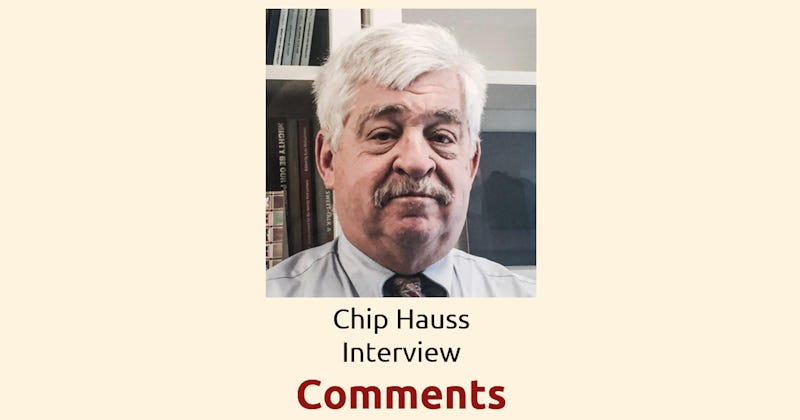

We received two comments on Chip Hauss's talk about his book Peacebuilding Starts at Home, one from Sanda Kaufman, Professor Emerita of Planning, Public Policy, and Administration at Cleveland State University (and co-author with us of the Conflict Resolution Quarterly article on hyper-polarization and its threat to democracy which initiated this discussion). The second comment was from Harry Boyte, Senior Scholar in Public Work Philosophy at Augsburg University and co-founder of the Institute for Public Life and Work. We have some additional comments that we didn't have time to talk about when we talked with Chip, so we are adding those thoughts here as well. We hope others will join this discussion if you are so inclined, Chip included!
Sanda observed that Chip’s notion that peacebuilding should start at home was quite similar to our notion of massively parallel peacebuilding. Both rubrics assert that we need a great deal of work that, when done abroad, is called “peacebuilding,” but when done domestically, is called “bridging,” or “civic engagement,” or “dialogue and deliberation,” or other such processes that involve grassroots citizens, not just the ruling elite.
Sanda was also very much in agreement with Chip’s challenge to the field when he asked “How dare we tell people in Burundi or Bosnia or Brazil that we can help them solve their problems if we don’t do it in Baltimore?” Indeed, she, and we, have been saying the same thing for as long as we have been working in the field, which for all three of us, is a long time. So we, like Chip, are very glad to see the peacebuilding field finally recognizing that we have conflicts at home that are worth our attention.
However, Sanda thought Chip didn’t focus enough on the point that his “side” (which is progressive) doesn’t have all the answers, and all these processes he talks about aren’t simply for the purpose of “bringing the other side around.” Instead of falling into the all too common trap of trying to get the other side to adopt the progressive (the right way) of thinking, Sanda thinks that peacebuilders ought to focus on joint problem-solving:
I think what we need is to find ways to develop a kind of “joint fact finding” ... We have a deep problem with using non-intersecting sources of information, so that almost everybody is missing half the picture and arrives at logical conclusions based on half of the story. It’s very damaging to decision-making.
This seems to me almost simpler than what Chip is proposing. He wouldn’t need to bring people around to his point of view. Rather he could examine his point of view along with theirs and come up with a joint understanding of “the facts” as a result that would, almost certainly, be some combination of where each side started from.
She then discussed how that related to what was happening in Minneapolis (writing after Renee Good was shot and killed, but before Alex Pretti was killed. She observed that most everyone she read and talked to about this tragedy had come to a firm conclusion without having really looked at the facts (or even waiting for the facts to emerge). The initial Good videos were ambiguous, but everyone chose the one or two videos to focus on that supported their own narrative of what happened. The same thing happened, she said, in a discussion with friends about school funding and charter schools. They all had firm opinions, but didn’t have the facts upon which to base those opinions. (This tendency to make firm decisions based on incomplete and misleading facts is something that we wrote about in an earlier post on what we called the QED trap—scroll down, it is the second article on this page.)
We agree with Sanda, that joint fact finding, whenever possible, can be very helpful in diminishing conflict and promoting better decisions. There certainly should be a joint inquiry into what happened in Minneapolis — leading up to and following Renee Good’s and Alex Pretti’s deaths. (This article reinforces this notion.) Why did ICE target Minneapolis in the first place? Why did they decide to bring such a strong and menacing presence into the city? What were they doing in the days leading up to the killings? What was the public response to ICE’s actions? Was it primarily nonviolent? Violent? In the hours and minutes immediately before the killings, what was ICE doing? What were Renee Good and Alex Pretti doing? What were the protesters doing? In short, what were the many factors that led to the shooting of Renee Good and Alex Pretti? And, what (if anything) is being done to de-escalate the situation now?
These are all questions that need to be investigated by a body that is trusted by all sides of the immigration debate. If we were designing such an inquiry, we would try to create some sort of “blue ribbon committee” made up of local officials (some in law enforcement, some not, some left-leaning, some right-leaning), representatives of ICE (Immigration and Customs Enforcement) and CBP (Customs and Border Protection), some representatives of activist groups that have been involved in the immigration issues in Minneapolis, such as MIRAC - the Minnesota Immigrant Rights Action Committee and the Minnesota Interfaith Coalition on Immigration (ICOM), and some private citizens, again, some right-leaning and generally opposed to immigration, and some left leaning and generally in favor of immigration.
If a diverse committee like that were to examine all the available evidence (and were to be able to issue subpoenas to get relevant evidence) its findings would be much more likely to be believed by parties on all sides of the immigration conflict. If, however, no investigation takes place, or if ICE does its own closed-door investigation (or if it destroys or withholds evidence as is currently being reported), then many people will distrust the findings of the investigation, and are likely to respond even more negatively to the situation. Bottom line: this is a clear case (as are many) when joint fact-finding is essential for de-escalation, fairness, and good decision-making.
Sanda went on to say that she liked Guy’s question to Chip about vision. Guy asked whether Chip had “given any thought to a kind of unifying vision with which we could say, ‘Okay, let’s all unite around these principles — principles that people on both the left and the right could see as a different, and much more promising, way forward that they’d be willing to work toward.’” Guy went on to say that we thought that Karen Armstrong’s Charter of Compassion, which encourages people to act in the spirit of the “Golden Rule” (do unto others as you would wish them to do unto you) would be a good start.
Sanda said she agreed with that notion, although she wasn’t convinced that the Golden Rule is as universal as Karen Armstrong claims. Armstrong says some version of the Golden Rule is present in all the world’s major religious traditions (though it often competes with other contradictory teachings). Her goal was to mobilize a global social movement aimed at restoring this principle to the forefront of religious teaching. Sanda especially liked the fact that this principle was “simple,” and hence understandable and workable. It is way more feasible, she thought, than Rotary’s “Four Way Test” that Chip referred to.
Is it the truth?
Is it fair to all concerned?
Will it build goodwill and better friendships?
Will it be beneficial to all concerned?
This [Sanda observed] is way more ambitious [than the Golden Rule] and infeasible.
The truth is difficult to establish most of the time (see my examples above).
Is it fair to all concerned? I’d settle for “most,” not “all,” and who is to say what is fair? It reminds me of the quest for optimality and Kenneth Arrow’s impossbility theorem. [This theorem shows that the quest for a perfectly optimal, fair, and logical method of combining individual preferences into a single group preference is mathematically impossible.]
Goodwill and better friendships? He forgot whipped cream in everyone’s coffee at all times. I’d settle for much less. Absence of physical violence, perhaps? I don’t need to be friends with everyone.
Beneficial to all concerned? How about minimizing harm? How about the ability to be oneself?
I prefer the golden rule. It’s golden for its clarity.
We (Guy and Heidi) had some of the same thoughts about the Rotary 4-way test, although more about items 1 and 2, more than 3 and 4. We think acting in ways that build goodwill and friendships is always good. It is very similar to our observation that we should treat everyone with respect, even if we don’t think they deserve it. Respect is easy to give (it doesn’t cost anything) yet it can break down negative stereotypes and be very disarming. You don’t need to agree with everyone, or accept their bad behavior as okay. But if you hear them out and respond calmly without attacking them, your chance for effective problem-solving goes way up. And it makes it much more likely that they will hear you out in return, and create at least a modicum of goodwill.
Beneficial to all concerned? Sanda is right — this is often impossible to do, particularly if people’s desires are polar opposites. But as Fisher, Ury, and Patton observed years and years ago in Getting to Yes, far too many people (particularly those trapped in an intractable conflict) frame their desires in terms of positions, not interests and these positions, typically appear to be polar opposites. (”I am in favor of immigration” versus “I am opposed to immigration.” Or, “I am in favor of a woman’s right to choose,” versus “I am opposed to all abortions.)”
But if one looks at the interests, (in other words, the reasons behind those positions), it turns out most people agree on general principles, for instance, the need for comprehensive immigration reform, the need to better secure the border, improving the legal immigration process, dealing fairly with undocumented immigrants (particularly “DREAMERS” — immigrants who were brought into this country as children and often know no other “home.”) Indeed, the Republicans and Democrats have been close to passing bi-partisan immigration reform at least twice. The last time, Trump scuttled the bill, wanting to keep immigration as a contested topic during the 2024 elections. But it is a “solvable problem” if one is willing to look at interests and work to develop a program that benefits almost all concerned. No doubt, some people will still be hurt. But the goal of working to benefit most is far better than the hurting everyone approach that we are taking now.
But our concerns were primarily about items 1 and 2 in the four-way test. I had wanted to ask Chip about it when we talked to him, but we ran out of time. But how do you determine “what is true?” Now, I do believe that “truth exists,” and do not think everything is relative to who is looking as some on the left would assert. But “truth” is extremely hard to agree on in intractable conflicts, and you cannot have a comprehensive joint-fact-finding process before you do or say anything. At least that dictum should be qualified by saying “Is it true to the best of my knowledge?” And then, maybe I’d add for controversial topics, “Have I checked?” “Have I considered what the other side is saying and why?”
Likewise “is it fair?” Measuring fairness is harder than measuring truth, because there is no objective rubric. Does “fair” mean equal outcomes, no matter what the input? So everyone gets the same thing, no matter how hard they worked? Or does “fair” mean outcomes commensurate with inputs, so people who work harder get more? But what if people want to work harder but don’t have the opportunity? (They couldn’t get a job because they didn’t have good schooling, or they were discriminated against). Is “fairness” remedying such past inequities? So is it fair to give differential treatment to people of color and LGBTQ+ because they (or people that share their racial or gender characteristics) have been discriminated against in the past? These are all very controversial questions. So asking “is it fair,” and hoping for a quick and simple answer seems fanciful.
Having said all of this, we should emphasize that, in the great scheme of things, these are relatively small quibbles. Both Chip and Rotary deserve praise for trying to put questions of truth, fairness, and goodwill into the center of our political conversations. We live at a time when such issues don’t get anywhere near the thoughtful attention they deserve.
Even though fairness is hard to define, it is still critically important. Fairness principles are the principles that make Fisher and Ury’s principled negotiation the most powerful strategy for working through our differences. Just as joint fact-finding can help us find our way through many difficult situations, a joint discussion of what constitutes fairness could do much to guide us toward a future in which we would all like to live.
While we doubtless will continue to have trouble deciding what constitutes true fairness, we ought to be able to agree that some things are grossly unfair and ought to be corrected. If we can just succeed in correcting some of these things, we will have accomplished a great deal.
Our colleague Harry Boyte also commented on Chip’s book and interview. Harry’s lifelong engagement has been citizen engagement and problem-solving — he talked about this a lot in the interview we did with him in December 2024. Harry’s take on Chip’s initiative was very positive:
This is an important interview (along with the WIlk’s World one today). [This is a podcast that coincidentally came out the same day as ours.] [If you] think of this in “civic” terms: peacebuildng plus a public, horizontal identity dimension, and a different, generative understanding of power, it’s very close to the mission of the about-to-be announced Civic Scholars Council of Braver Angels.
We just recorded an interview with Harry in which he elaborates on this idea and the Civic Scholars Council. The post on that will be coming out in a week or two. But, as we understand it, his term “generative understanding of power” is similar to our notion of “integrative power or “power-with“ . So stay tuned -- a great, related, conversation with Harry is coming soon!
In the meantime, let us know what you think about starting peacebuilding at home and consider signing up with Chip’s effort.
Please Contribute Your Ideas To This Discussion!
In order to prevent bots, spammers, and other malicious content, we are asking contributors to send their contributions to us directly. If your idea is short, with simple formatting, you can put it directly in the contact box. However, the contact form does not allow attachments. So if you are contributing a longer article, with formatting beyond simple paragraphs, just send us a note using the contact box, and we'll respond via an email to which you can reply with your attachment. This is a bit of a hassle, we know, but it has kept our site (and our inbox) clean. And if you are wondering, we do publish essays that disagree with or are critical of us. We want a robust exchange of views.
About the MBI Newsletters
Two or three times a week, Guy and Heidi Burgess, the BI Directors, share some of our thoughts on political hyper-polarization and related topics. We also share essays from our colleagues and other contributors, and every week or so, we devote one newsletter to annotated links to outside readings that we found particularly useful relating to U.S. hyper-polarization, threats to peace (and actual violence) in other countries, and related topics of interest. Each Newsletter is posted on BI, and sent out by email through Substack to subscribers. You can sign up to receive your copy here and find the latest newsletter here or on our BI Newsletter page, which also provides access to all the past newsletters, going back to 2017.
NOTE! If you signed up for this Newsletter and don't see it in your inbox, it might be going to one of your other emails folder (such as promotions, social, or spam). Check there or search for beyondintractability@substack.com and if you still can't find it, first go to our Substack help page, and if that doesn't help, please contact us.
If you like what you read here, please ....