
Finishing our Fiddling Discussion (for awhile) with Four New Voices
Newsletter 441 - April 1, 2026

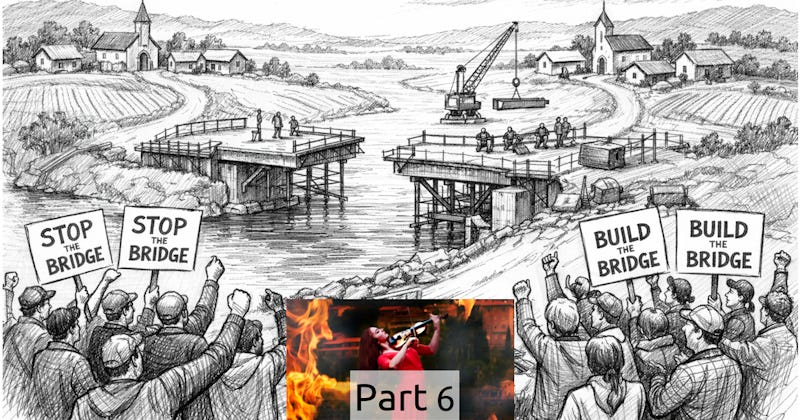

This is the third and final response to David Beckemeyer, Kristin Hansen and Pearce Godwin's discussion of what we call "Fiddling While Rome Burns," and Kristin succinctly calls "fight or bridge"? In our first post, we included a link to David's original essay "What Bridge Building Owes Democracy" and our response to it, which took three newsletters this, this, and this.) We also included Kristin and Pearce's response to both David and us, and a link to David's second newsletter replying to all of us: The Bridge, the Arena, and the Referee: A Response to Guy and Heidi Burgess and Pearce Godwin. Pearce and Kristin both then responded to David's Bridge, Arena, and Referee post which we shared in Newsletter 440, and here, in the third post we add our own comments to all of this, along with thoughts from Harry Boyte, Marie Strӧm and Scott Vineberg. We appreciate your patience and hope you find the discussion valuable!,
Guy and Heidi’s Response to Everybody
First, thanks to David for starting us off on this discussion, and to Kristin and Pearce for making it so rich, and allowing us to share it here, as well as on David’s Substack, Outrage Overload.
We will start by echoing David’s response to us: “we agree on far more than we disagree” — with David, Pearce, and Kristin.
We think some particularly useful ideas have come out of this conversation. First, we think we all agree that “peace” (meaning people of all different stripes living together without violence and with a modicum of mutual respect — Pearce’s notion that people have to be willing to accept others as “human” is very important. (And it is sadly astounding that we have to write that!) We also agree that fixing and building upon our system of liberal democracy is critically important. Like Kristin, we don’t see this as an either-or, or even a do-this-first-and-this-second situation. Both peace and democracy have to be pursued simultaneously. Hearkening back to what I learned in introductory biology, they are in a symbiotic relationship—each requires the other to succeed.
So then the question becomes how do we pursue both at once? Does it require different people playing different roles? Do we need referees (who are different from the bridge-builders) who focus on protecting the rules of the game, calling fouls as they see them, and imposing penalties for transgressions? Or, should, as David suggests, bridge-builders simultaneously act as referees?
We think the answer depends on the arena one is talking about. If one is facilitating a bridge-building dialogue about a contentious topic, for instance voting laws, the dialogue facilitator certainly should establish a set of ground rules for the discussion and enforce those. Those ground rules should ensure that all participants are treated with respect, that they are allowed to, indeed encouraged to, say what they think without fear of reprisal. Also, all participants should be encouraged to actively listen to and engage with all points of view expressed, including those which they find challenging, even painful, though they can certainly openly note their pain.
Should the facilitator also make a decision about what voting rules are “democratic” and which are not, and call out any participant who advocates for something that, by their definition, is not democratic — for instance, if someone says voters should required to show identification to vote, should the facilitator call them out on that? We think they should not. Supporting or opposing particular voting policies is a decision that individual participants and, perhaps, the group as a whole need to grapple with after hearing views on all sides. The purpose of the discussion is often to simply develop a better understanding of the issues at play, so that participants can later make better decisions about their own political preferences.
There are many arenas other than bridge-building dialogues in which citizens can advocate for particular policies. There is social media, town-hall meetings, city council and state-legislature hearings, citizen assemblies, political party meetings, and lots and lots of other places where advocacy for “democracy,” however one defines it, is completely appropriate. And bridge-builders can certainly attend such processes in those arenas and play an advocacy role there.
But they should be aware, we think, that if they do so in a very visible way, they are likely to be labeled as a “D” or an “R,” and hence, to most people, an “us” or a “them.” And that labeling might affect their ability to do a bridge-building work, even if they don’t want it to, and even if they are very skilled at keeping the dialogue open to all viewpoints. And that, unfortunately, is likely to limit the effectiveness of their work.
Such contagion has also likely contributed to the common complaint that it is very hard to get conservatives to participate in dialogues or other bridge-building activities. We do not think, as we have often heard, that conservatives are less willing to talk to the other side than progressives are. Rather, from what we read and have heard, the problem is that many conservatives have themselves participated, or have heard about others participating, in dialogues which were supposed to be neutral, but were not. Rather, they were used as an opportunity to convince the conservatives that their views were wrong, and that they should change them to more closely align with the progressive notions of “correct.” Most conservatives are, understandably, not interested in doing that.
So, if bridge-builders want to protect their ability to successfully build the broad coalition that all of us (David, Kristin, Pearce, Guy, and Heidi) seem to agree is needed to protect liberal democracy (which we all want to do), we think it is safer to leave the advocacy to others. In his Three R’s Statement that we quoted in Newsletter 434, Bill Doherty said that “If bridge-builders join the “Resistance,” they lose the cross-partisan trust required to bind the wounds of the nation later.” We think he is right. We need to remember that democracy is not a system for resolving societal disputes in accordance with one party’s definition of justice. It is a system for nonviolently managing competing definitions of justice. Doing this is, of course, the realm of referees who look at our conflicts from the perspective of the whole society, rather than just one small-group dialogue.
So bottom line, we think referees are critically important, as are bridge-builders. We should also point out that these roles are just two of the over 50 roles that we identified as being critical to the success of what we have long called a “massively parallel“ strategy for solving problems, strengthening democracy, and building peace (something that David Eisner has usefully reframed as “massively parallel action.”) While our list of massively parallel roles does not specifically include referees, it does identify a much larger array of roles that provide important refereeing functions. These include five types of “lookouts:” who warn us about threats to our democratic society: early warners, discrimination watchdogs, governmental watchdogs, geopolitical threat monitors, and canaries. There are also defenders who don’t just call out bad behavior, they try to defend society from those behaviors. Finally, there are the “democracy firsters“ who believe that defending democracy is a precondition for solving all of our other problems.
We were recently reminded by another reader that William Ury has “referee” as one of his “conflict containment” roles. Ideally, according to William’s Third Side rubric, one should prevent conflict with providers, teachers, and bridge-builders. If that fails, we should resolve conflict with mediators, arbiters, equalizers, and healers. And if that fails, we should contain it, with witnesses, referees and peacekeepers.
Sadly, we have reached the point where we desperately need people working at all of William’s levels and in all of his roles (or, in all of our massively parallel roles) simultaneously. Put another way, we need an all-of-the-above approach to our hyper-polarized political crisis.
Guy has a number of additional comments on various points made earlier:
We appreciate David’s clarification that bridge-builders should not become crusaders for the Democratic Party. He says that “My concern is not with which side ‘wins’ the next election, but with whether the democratic area itself survives the contest. We aren’t advocating for a team; we are advocating for the resilience of the system.” We agree with that totally. The problem is that the word “democracy” (and its many variants) have become so politicized that it’s hard to distinguish true efforts to protect democracy from efforts to use democratic rhetoric to advance a partisan agenda. I think we need to spend a lot more effort coming to a consensus about what democracy is and why it’s so important. (As our contribution to such a discussion, we tried to outline our thoughts in our post on the Grand democratic Bargain.)
David (like many others) also stresses that today’s threats to democracy are “asymmetric,” meaning that he thinks that the Republicans are a greater threat to democracy than are the Democrats. This is probably true at the moment, because the Republicans are in power, so they can do more damage to the democratic system than can Democrats at this time.
But, the assumption that all the threats to democracy are coming from the Republicans releases Democrats from the responsibility of noticing and correcting things that they have done to contribute to our current problems. (See our post on focusing on “contribution, not blame.“) This mindset prevents Democrats from seeing the weaknesses in their strategies that have led to their loss of support among traditional Democratic supporters, such as the working class and minority voters, who have increasingly voted Republican over the last several years. The Democrats would benefit considerably from learning why these voters left. Unfortunately, many Democrats still seem reluctant to consider such questions, and ignore or even quash voices that try to bring such topics to the fore. (See, as an example, the closing down of the very thoughtful blog that addressed such issues, the Liberal Patriot, which apparently was totally unable to find enough funding to continue to operate.)
A second problem with the asymmetric argument is that trying to decide who is worse takes the discussion about how to do better and how to strengthen democracy and changes it into another us versus them: we’re good, they are bad, so we need to vanquish them. It leaves us in the same hyper-polarized, fearful, and hateful state that we are in now.
In response to David’s assertion that “if the price of maintaining those [bridge-building] relationships becomes never naming authoritarian actions clearly, we risk building a coalition for keeping the peace rather than defending democracy,” we ask whether going to war (either figuratively or literally) would enable us to better defend democracy. We don’t think so. (If you’re having trouble imagining how bad things could get, look at this article about the civil war that is emerging in England.) It is hard to see how such a “war” could resolve the conflict in ways that both sides would accept. It is, however, easy to see how the dehumanizing hatred that inevitably accompanies such confrontations would produce a legacy of unrightable wrongs that it would take decades, if not centuries, to heal. (If the U.S. has yet to recover from its Civil War 150 years ago, how would a second civil war help?) We must, as we said earlier, defend democracy and peace at the same time.
We agree that it is important that we clearly define what we mean by “threats to democracy,” and we need to differentiate such threats from the business-as-usual hardball politics that have, unfortunately, been part of U.S. democracy for a very long time. (It would, of course be good to find ways of limiting the use of these tactics.) As a country, we have almost always practiced what we have called, in an earlier post, “power-over democracy,“ — a way of thinking about politics that makes use of techniques such as what Guy calls the “51% hammer strategy“ This strategy focuses on winning with the slimmest possible majority and then “hammering” the losing side to pay off one’s supporters. As a better alternative, we have been trying to highlight the benefits of building a true “power-with democracy“.
Still, we must acknowledge that the kind of hardball politics being practiced by President Trump is, in many ways, unprecedented. No one before Trump has encouraged rioters to march on the U.S. Capitol to disrupt the certification of the Electoral College vote, nor maintained for years afterward that the 2020 election was “stolen,” even as the Courts have unanimously rejected that claim. Similarly, no earlier President has called for “nationalizing” elections, or so overtly called for the prosecution of his real and perceived “enemies.” (Nixon’s enemies list is, of course, an obvious exception). Trump’s hostility toward our allies, and his staggering level of personal corruption are also, most likely, unmatched by any other U.S. President. These, we believe, are all true “threats to democracy” and should be vigorously opposed.
Having said all of this, it is important to remember that Democrats have played a major role in the ongoing process of democratic erosion. President Trump is, in many ways, a reactionary president who came to power in large part because of voter rejection of Democratic policies — policies which many, especially on the right, saw as threats to democracy that are comparable to the way in which the left sees Trump. For example, insisting that all government agencies, all universities that receive federal funds, and all businesses that do business with the federal government follow strict DEI policies that give preference to Democratic constituencies (defined according to race and gender identity) is seen by many as a clear example of anti-democratic machine politics. Another example involves the many ways in which “cancel culture” restraints on free speech are used to silence opposition. You can argue that these aren’t as serious as what Trump has done, but it doesn’t matter. They paved the way for Trump, and might well prevent Democrats from regaining power if they don’t promise to alter those policies.
So, as citizens of the United States, who are concerned about the strength and stability of our democracy, we should be concerned about all these things (and others) and we should seek the broadest possible coalition of people to oppose such anti-democratic actions. Building such a coalition requires decoupling partisan advocacy from the defense of democracy. It requires treating our political adversaries in the way that we would like them to treat us. It requires assuring that the rights of the losing side will be protected. We cannot do that by implying that Republicans are “worse” than Democrats, thereby alienating 50% of the electorate. We agree with Kristin, who said that we need to keep creating spaces for “listening, curiosity, trust, and relationship-building between Americans of different political and ideological leanings ... creating the conditions from which an American supermajority for constitutional democracy can emerge.”
We also need to be clear about what we mean by “peace.” Sociologists and peace studies scholars make the distinction between “negative peace,” which is simply the absence of war, and “positive peace,” which is a much broader concept including all of the conditions which allow humans to thrive together. Neither define “peace” as the absence of conflict. Conflict is inevitable in human societies, and is actually beneficial when it is carried out constructively. As we have argued elsewhere, democracy is, in essence, a conflict-management system that is far preferable to the alternative, coercion-based system of “I’ll-Fight-You-For-It” rules that inevitably demonstrates the validity of Lord Acton’s observation that power corrupts and absolute power corrupts absolutely. So, we should all work together to build a healthy, peaceful democracy which contributes to positive peace, not just negative peace.
In order to do this, we also need to be clear about what the key components of democracy are which we have to protect. Coming up with such a vision is an important task for bridging conversations, because we will only succeed if we work towards goals that are shared by most, if not all, Americans. If our goals are only shared by half of the country, we will not only fail to achieve them, we will fail to defend democracy as well. (We proposed some things to think about in Newsletter 407, and again with ChatGPT’s help in Newsletter 426.) But this is a much longer conversation than we have room for here.
We very much like Pearce’s “6 Keys to Conversations That Bridge Divides. This is very similar to what we have called “Constructive Confrontation,” which we see as a more promising way to pursue de-polarization, citizen renewal, and democracy than calling people out, even when they are wrong.
The bottom line of all of this, it seems to us (and we think David, Pearce, and Kristen would likely all agree), is that we are living in a very dangerous, but very complex and dynamic situation. In order to build a more positive future, we need lots of people doing lots of different things, pursuing their own goals, in their own ways (what we call “massively parallel action). But they need to try, as best they can, to not impinge on others who are pursuing different goals, as long as those goals are roughly consistent with democracy and peace in the broadest sense of the words. (We can and should challenge those who are pursuing violence or, as Pearce says, clearly dehumanizing behavior.) But we do, also, need to be clear and transparent about what role we are playing, and not try to play two roles at the same time, when their goals are not compatible.
P.S. from Harry Boyte, Marie Strӧm and Scott Vineberg
Right before this was sent out, Harry Boyte and Marie Strӧm sent us a report on a Braver Angels meeting held in Minneapolis/St. Paul shortly after ICE had left, reflecting on motivations for bridge-building work in that climate. Harry and Marie wrote:
The meeting surfaced important questions: Has the immense outpouring of civic support for immigrants and others targeted by ICE agents led to new relationships across differences and made visible immigrant communities which were often unseen? Are we more fractured as a Twin Cities community along partisan lines than we were before ICE? Is resisting injustice and threats to democracy the first priority? Is “bridge-building” a distraction? Is it more important than ever? ...
Harry and Marie didn’t provide answers to those questions, but said it was an “honest, open, and many-voiced conversation. They did observe that:
Holding passionate beliefs and taking strong civic action while learning to love even our “enemies” is hard work. Many felt that putting resistance and bridge-building in opposition to each other is a false binary; they should be seen as complementary – both/and not either/or. Learning the skills and sensibilities of respecting and developing curiosity about those who think differently is key to becoming more effective civic agents of change. It is one of the six principles of nonviolence – learning to understand, not humiliate.
And Scott Vineberg sent a similar message:
Beyond ‘fight or bridge’: focus on surfacing common ground and acting on it. Model and propagate: local people setting priorities, developing solutions and taking action in and through consensus. That’s both real resistance to the status quo and the most effective form of bridge-building.”
Thanks, all, for an important discussion! We're moving on to other topics for awhile, but we are sure this topic will come up again.
Please Contribute Your Ideas To This Discussion!
In order to prevent bots, spammers, and other malicious content, we are asking contributors to send their contributions to us directly. If your idea is short, with simple formatting, you can put it directly in the contact box. However, the contact form does not allow attachments. So if you are contributing a longer article, with formatting beyond simple paragraphs, just send us a note using the contact box, and we'll respond via an email to which you can reply with your attachment. This is a bit of a hassle, we know, but it has kept our site (and our inbox) clean. And if you are wondering, we do publish essays that disagree with or are critical of us. We want a robust exchange of views.
About the MBI Newsletters
Two or three times a week, Guy and Heidi Burgess, the BI Directors, share some of our thoughts on political hyper-polarization and related topics. We also share essays from our colleagues and other contributors, and every week or so, we devote one newsletter to annotated links to outside readings that we found particularly useful relating to U.S. hyper-polarization, threats to peace (and actual violence) in other countries, and related topics of interest. Each Newsletter is posted on BI, and sent out by email through Substack to subscribers. You can sign up to receive your copy here and find the latest newsletter here or on our BI Newsletter page, which also provides access to all the past newsletters, going back to 2017.
NOTE! If you signed up for this Newsletter and don't see it in your inbox, it might be going to one of your other emails folder (such as promotions, social, or spam). Check there or search for beyondintractability@substack.com and if you still can't find it, first go to our Substack help page, and if that doesn't help, please contact us.
If you like what you read here, please ....