
Are Our Intractable Conflicts Really So Intractable? Claude (AI) Doesn't Think So
Newsletter 444 - April 9, 2026

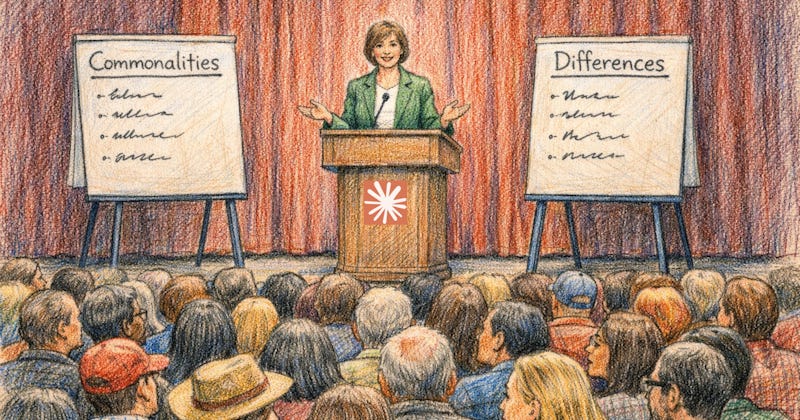

Are We Really As Divided As We Think We Are?
Our hyper-polarized U.S. society is engaged in a number of very high-stakes conflicts in which it is widely believed that a victory by the other side would be absolutely intolerable — something to be fought by pretty much any means necessary (hovering, for the moment, just short of violence). There are also a great many people who believe that these conflicts are uncompromisable — they determine whether the arc of history will bend toward justice or away from it.
Are things really this bleak?
More in Common argues that they are not. While there are certainly people on both the right and the left who hold extreme views, More in Common’s Hidden Tribes and Perception Gap projects both illustrate that the views of people closer to the center are not nearly as divergent as people tend to think they are. We find this to be true in our experience as well.
When we were still teaching, we developed an exercise that helps people explore the nature of our differences, our areas of common ground, and how we might work through our differences constructively to come up with agreed-upon solutions or policies. Whenever we ran this Common Ground Exercise, participants usually found out that their divisions were not as intractable as they thought they were. We used this exercise for years with students and other non-student groups that were interested in exploring difficult conflicts more deeply, to find areas of difference and agreement and how we might be able to address these differences more constructively.
How the Common Ground Exercise Works
The exercise is done in small groups, ideally with participants on both the left and the right. (When we did it with students who tended to mostly lean left, we chose topics on which there was still considerable disagreement, which we determined by polling students in advance. If that proved impossible, we had students read arguments (or watch videos) on both sides of the issue, and then asked some students to role-play the other side. This isn’t as good, of course, as having people represent themselves, but it is still instructive.)
The exercise, which we continued to refine over the years, asks participants to consider six questions as they relate to some especially intractable conflict.
On what issues, sub-issues, and facts do you think there is broad agreement among members of contending groups?
On what issues, sub-issues, and facts do you think there is clear and strong disagreement among members of contending groups?
To what extent is each disagreement attributable to different images of objective facts? And, to what extent is each disagreement attributable to differing values or moral beliefs?
For differences attributable to differing images of objective facts, can participants imagine some sort of joint fact-finding process that would resolve each disagreement in ways in which all could have confidence?
For differences attributable to differing values or moral beliefs, which differences fall within the limits of socially acceptable differences of opinion — differences that, in a free society, can be accepted in the spirit of mutual tolerance and respect, coexistence, and a general willingness to “live and let live”? And which are so morally reprehensible that they need to be actively and vigorously opposed?
For beliefs that people feel need to be actively opposed, how do people think that that can be most constructively done?
Our full description of the exercise discusses each of these questions in detail, and suggests prompts that teachers/facilitators can use if people get stuck. With a little help, participants almost always find that there are areas of broad agreement between even the most seemingly opposed people — for instance, even between pro-choice and pro-life advocates, everyone agrees that abortion should not be used as a form of birth control.
An Experiment: We Asked Claude to Do the Exercise on Behalf of “Typical Americans.”
As our frequent readers know, over the last few months we have been thinking about ways in which our field might be able to benefit from AI’s ability to listen to very large numbers of people and summarize what they collectively have to say about particular topics. So, we thought it would be interesting and perhaps useful to see what we could learn by asking Claude to work through our common ground exercise as it applies to three different high-profile and particularly contentious topics. We chose climate change, DEI, and immigration. (This is an extension of our earlier and reasonably successful effort to see how well AI might be able to synthesize a collective vision for what a democracy in which we would all like to live might look like).
We have been having good luck with Claude lately, so we gave Claude the detailed directions for our common ground exercise, and then asked it to compile, based on all that it has read, a report on how it thinks that a truly a representative group of Americans might answer our six questions. We first asked it to do that for climate change, then immigration, then DEI programs. Its original answer was 32 pages long. For those who are interested, we are including its full answers for all three topics in a separate document: Claude Does The Burgess’s Common Ground Exercise on Climate, DEI, and Immigration.
Here we are sharing its answers to the first question about commonalities, which we find particularly interesting because it says there are more than most of us assume there are. It is worth noting, that as I read some of these, my thought was sometimes, “no, that’s not right! I don’t agree with that! Or, “I know a spokesperson for the other side that doesn’t agree with that.” But before Claude gave its answers, it explained its method by saying:
The exercise imagines a room containing Americans from across the full political spectrum — far right, right, center, left, far left — attempting an honest, structured conversation. It does not pretend that all positions are equally well-supported by evidence. But it does attempt to represent each position fairly, to understand the genuine moral seriousness behind disagreements, and to find whatever real common ground exists.
The answers below are synthetic — they represent what a careful observer, familiar with the full range of American political opinion, believes each camp actually holds, not what any single individual or organization has said. The goal is honest representation, not flattery or false equivalence.
Given how much more widely read Claude is than I am, maybe it is right. It is certainly worth considering that possibility. At the same time, we all know, AI makes mistakes. It can “hallucinate.” Is it hallucinating these areas of common ground? Maybe. But isn’t it worth considering the possibility that they are real and trying to get people together to explore them more and perhaps start acting on them might be useful?
Every time we ran this exercise with face-to-face groups, the answers that people came up with were very different. Given different backgrounds and interests and the limited time available for the exercise, this is hardly surprising. It is also clear that there is no way that, with a reasonable amount of time and effort, face-to-face dialogues could ever be able to deeply listen to and synthesize the diverse array of voices that Claude is able to consider. Such conversations just don’t have the bandwidth necessary to exchange that volume of information.
This technology also has big advantages over survey research and polling — the primary strategy that social and political scientists and the media generally use to understand what large groups of people think. AI Projects like this one allow us to see our conflicts with a tremendous amount of nuance — nuance that is missing from opinion polls that usually reduce complex issues to a few simple Likert Scale questions, where the possible answers range from “strongly agree” to “strongly disagree.”
For those who are trying to promote a better understanding of what our society collectively thinks, this is a revolutionary technology. The challenge is to figure out how to integrate this tool with the kind of face-to-face efforts that are still essential for bridge-building and trust building — prerequisites for consensus-building and collaborative action, processes that many consider to be “fixes” to our current hyper-polarization. One next step is for each of us to think about what the information revealed in these reports suggests about how we might be able to approach our conflicts more constructively.
Common Ground
In this newsletter, we will summarize Claude’s assessment of areas of common ground that it thinks exist with respect to climate, DEI, and immigration. In a coming newsletter or two we will turn our attention to the areas of disagreement that Claude identifies and strategies for working through those disagreements.
Claude’s Common Ground Findings on Climate:
Climate change is one of the most politically polarized topics in American life, and the polarization is real. But it obscures a more substantial area of shared ground than most partisan debate acknowledges.
Areas of genuine cross-spectrum agreement:
The climate has always changed, and the recent decades have brought measurably more extreme and costly weather events. Even those who dispute the dominant account of human causation generally acknowledge that floods, wildfires, droughts, and hurricanes are more frequent and more damaging. The costs are visible and undeniable.
Clean air and clean water are almost universally valued. Whether the frame is environmental stewardship, Christian dominion theology that emphasizes care for creation, public health, or progressive environmentalism, virtually everyone agrees that polluted air and water are bad and worth preventing.
Energy security and independence are national priorities. Across the spectrum, Americans broadly agree that dependence on foreign energy sources — particularly from adversarial nations — creates strategic vulnerability. This point connects energy policy to national security in ways that generate cross-partisan support.
Energy costs matter enormously for working families, rural communities, and American industry. No political faction wants expensive, unreliable energy. Disagreements are about how to achieve affordable and reliable energy, not about whether those goals matter.
Technology and innovation will play a central role in any energy future. From conservatives who favor market-driven technological development to progressives who support public investment in clean energy R&D, there is broad consensus that the energy challenges ahead require technological solutions.
The costs of inaction are real. Even among those skeptical of the worst-case projections, there is wide acknowledgment that extreme weather events impose enormous economic costs — on property, insurance, agriculture, and infrastructure — and that some level of adaptation investment is prudent regardless of the debate about causes.
Future generations have a legitimate claim on current decisions. Even the most economically focused conservatives generally acknowledge that decisions with long-term environmental consequences should take some account of the world we leave to our children and grandchildren.
Energy transition communities deserve support. There is broad agreement, though disagreement about specifics, that workers and communities economically dependent on fossil fuels should not simply be left behind if the energy economy shifts. This commitment is shared across party lines, even when the policies proposed to fulfill it differ sharply.
Claude’s Common Ground Findings on Diversity, Equity, and Inclusion (DEI)
DEI is perhaps the most semantically and emotionally loaded topic in contemporary American life, in part because the same words mean very different things to different people. Beneath the terminological conflict, there is more shared ground than the loudest voices suggest — though it is sometimes expressed in very different language.
Areas of genuine cross-spectrum agreement:
Discrimination based on race, religion, gender, or national origin is wrong and should be illegal. This is close to a universal commitment across the American political spectrum, though disagreements about what constitutes discrimination are sharp.
Equal opportunity — the idea that people should be judged on their abilities, character, and effort rather than on inherited characteristics — is almost universally endorsed as an aspiration. The left and right differ profoundly on whether current institutions actually deliver equal opportunity; they disagree much less on whether equal opportunity is the right goal.
Historical discrimination in the United States was serious and real. Slavery, Jim Crow laws, exclusion from the GI Bill, redlining, employment discrimination — these are historical facts that are not seriously contested across the political spectrum. What is contested is their relevance to present-day policy.
Historical discrimination had lasting effects that did not simply vanish with civil rights legislation. Even on the right, there is general acknowledgment that generations of exclusion from wealth-building opportunities, quality education, and full civic participation have had lasting consequences. The disagreements are about magnitude and policy implication, not about whether any lasting effects exist.
Every person deserves basic dignity and respect regardless of their race, ethnicity, gender, or background. This commitment is stated across all political camps.
Diversity of perspective and experience can add value in institutions and teams. Even among critics of formal DEI programs, there is general acknowledgment that diverse teams often think better and avoid the blind spots that homogeneous groups can develop.
Discrimination on the basis of race remains legally prohibited and should remain so. This commitment is broadly shared even among those who argue that some DEI programs themselves constitute impermissible racial discrimination.
There are still real barriers that disadvantage some groups. Even among those who reject the framing of systemic racism, there is acknowledgment that discrimination — individual, institutional, and cultural — has not been eliminated, and that specific instances of unfair treatment deserve redress.
Claude’s Common Ground Findings on Immigration
Immigration is among the most emotionally charged issues in American politics. But when people across the political spectrum are asked what they actually believe — rather than which side they are on — a surprising amount of common ground emerges.
Areas of genuine cross-spectrum agreement:
The current immigration system is broken and needs reform. This may be the single most widely shared statement in American immigration politics. From the far right to the far left, there is broad consensus that the current system — characterized by enormous backlogs, inadequate legal pathways, inconsistent enforcement, and a broken asylum process — does not serve anyone well. The disagreements are about what reform should look like, not about whether reform is needed.
The United States has historically been a nation of immigrants and has benefited enormously from immigration. This is acknowledged across the political spectrum, including by those who favor sharp reductions in current immigration levels.
People who immigrate legally and follow the rules deserve respect, welcome, and full civic participation. The commitment to lawful immigration as a legitimate and valued path is broadly shared.
Border security is a legitimate function of government. There is broad agreement that the federal government has both the right and the responsibility to maintain some control over who enters the country. Disagreements are about methods, priorities, and the appropriate relationship between enforcement and humanitarian obligations.
Human trafficking and drug smuggling are serious problems that deserve vigorous response. Across the spectrum, there is strong condemnation of the criminal networks that profit from illegal immigration and engage in exploitation, trafficking, and violence.
Employers who knowingly hire undocumented workers and exploit them should face meaningful consequences. The argument that unscrupulous employers undermine both the rule of law and the labor market cuts across conventional left-right lines.
Children brought to the United States at a young age deserve special consideration. The situation of DREAMers generates sympathy across party lines. Polling consistently shows majority support for some form of legal protection for this population even among those who favor overall restriction.
Refugees fleeing genuine persecution deserve humanitarian consideration. The principle of non-refoulement has broad, if not universal, support. Disagreements are about scope and administrative capacity, not about whether the underlying humanitarian obligation exists.
Immigration enforcement should be conducted with basic human dignity. Even among strong supporters of vigorous enforcement, there is broad acknowledgment that enforcement operations should be conducted humanely and that immigration detainees retain basic rights.
Next: Claude’s Assessment of Our Differences
We find Claude’s analysis of areas of common ground to be quite hopeful. It demonstrates a sound basis for the kind of collective vision that, if adequately cultivated, could help us reverse the hyper-polarization spiral and restore conflict’s role as an engine of social learning. Still, the real challenge is figuring out how to overcome the obstacles posed by our differences. Here too, Claude’s analysis offers hope. It’s strategies for using joint fact-finding processes to work through factual disagreements offer real promise, as do its strategies for more constructively addressing the deep moral disagreements that remain.
Given how long this newsletter is already, we will defer a summary of these ideas to a future newsletter or two. In the meantime, you can find these answers by reading ahead and looking at Claude’s full response.
Please Contribute Your Ideas To This Discussion!
In order to prevent bots, spammers, and other malicious content, we are asking contributors to send their contributions to us directly. If your idea is short, with simple formatting, you can put it directly in the contact box. However, the contact form does not allow attachments. So if you are contributing a longer article, with formatting beyond simple paragraphs, just send us a note using the contact box, and we'll respond via an email to which you can reply with your attachment. This is a bit of a hassle, we know, but it has kept our site (and our inbox) clean. And if you are wondering, we do publish essays that disagree with or are critical of us. We want a robust exchange of views.
About the MBI Newsletters
Two or three times a week, Guy and Heidi Burgess, the BI Directors, share some of our thoughts on political hyper-polarization and related topics. We also share essays from our colleagues and other contributors, and every week or so, we devote one newsletter to annotated links to outside readings that we found particularly useful relating to U.S. hyper-polarization, threats to peace (and actual violence) in other countries, and related topics of interest. Each Newsletter is posted on BI, and sent out by email through Substack to subscribers. You can sign up to receive your copy here and find the latest newsletter here or on our BI Newsletter page, which also provides access to all the past newsletters, going back to 2017.
NOTE! If you signed up for this Newsletter and don't see it in your inbox, it might be going to one of your other emails folder (such as promotions, social, or spam). Check there or search for beyondintractability@substack.com and if you still can't find it, first go to our Substack help page, and if that doesn't help, please contact us.
If you like what you read here, please ....