
July 4, 2026: an Occasion for Recommitting Ourselves to the Pursuit of the Democratic Ideal - Part 2
Newsletter 469 - July 3, 2026
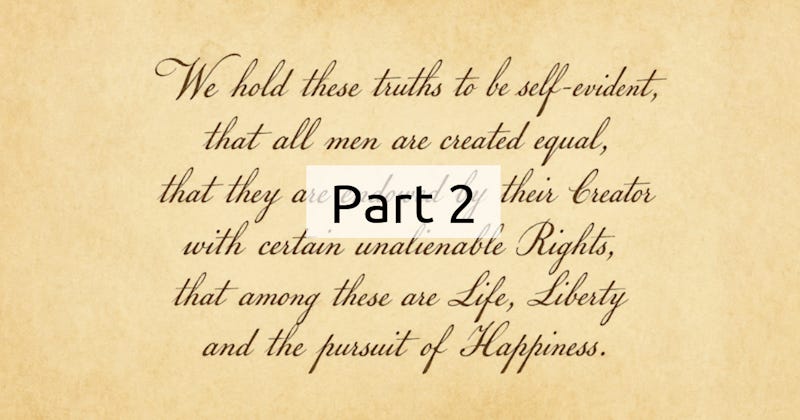

This is the second half of our Fourth of July post. The first half compared what Americans think now about the holiday, compared to what they thought about it last year (according to ChatGPT). We then observed that we have a choice: we can continue to fight over what America was, is, and should be. Or we can try to use this holiday as an impetus to come together to figure out how we want to overcome our many challenges and improve U.S. democracy together. We explained why we thought we should do the latter, and today we go on to consider what that might mean.
We ended yesterday’s post by saying:
Before condemning democracy, its critics should spend more time looking outside their immediate lived experiences to the experiences of people who have had to live under [what Winston Churchill referred to as] “all of those other forms of government that have been tried” — forms of government that Churchill knew were far worse [than democracy]. We need to remember that, despite our many differences and difficulties, there are bigger things that should hold us together.
Among those are...
Life, Liberty, and the Pursuit of Happiness
We believe that we ought to see the United States’ 250th birthday as a time to come together to celebrate and reaffirm our comittment to work together to defend and advance democracy’s founding goals of “Life, Liberty, and the Pursuit of Happiness.”
Life
We should honor life. That isn’t an anti-choice statement; We are not talking about abortion here. We are talking about the fundamental miracle of our own and others’ humanity and the larger wonder of creation. I (Heidi) was quite taken recently by an article in the Atlantic “The Ordinary Miracle of Existing.” It points out how “being alive at all is the most extraordinary stroke of good luck any of us will ever experience.”
Alan Lightman, the author, explains that
Far more possible arrangements of human DNA exist than there are atoms in the observable universe — each arrangement corresponding to a different human being. One of those many possible arrangements is each of us. ...
Each human female has about 300,000 eggs during the fertile period of her life. Each male ejaculation has about 300 million sperm. Thus each conception contains about a hundred thousand billion different possible combinations of DNA. In other words, there are a hundred thousand billion unique and different human beings that could result from each procreation event. Only one of those possible combinations led to each of you reading this article at this moment. Here’s a way to visualize that extremely tiny fraction. If you took a very long ruler that stretched from here to the planet Pluto, one inch of that distance would be you. The rest of the distance would be other possible human beings that could have been, but never were. Each of us has won a lottery with a hundred thousand billion different players. ...
Yet it [the miracle of our life] is the easiest to overlook, to take for granted. We wake up in the morning, have our coffee, make breakfast, send the kids off to school, go to our jobs, move through our routines, worry about deadlines, check off items on our to-do list. And we forget that beneath all of it lies something profoundly rare: existence itself. The simple fact that we are here, conscious and aware, is so unlikely that it borders on the miraculous. Because we experience that miracle every day, we treat it as ordinary, even guaranteed, mostly unnoticed at all. We postpone joy, assuming there will always be more time. We don’t see the beauty in small moments. We simply go about the business of life, without taking a second to notice life itself.
I put that together with the point Debilyn Molineaux made in her interview with us about how we, in the United States, don’t notice democracy; we don’t see how it impacts us.
Democracy is so assumed in our culture that we don’t understand its impact in our day-to-day life. And therefore, we also can’t imagine what our life would be like if we didn’t have it, or if we had a better system, a healthy political system.
And this made me think of today’s Free Press article by Coleman Hughes entitled “Progressive Patriotism.” It’s subtitle said: “There’s a reason the groups most valued by progressives — people of color, the poor, residents of the ‘global South’ — want to migrate to America.” And he went on to say
progressive ideology takes for granted what are in fact precious gifts that most people on Earth still don’t have or have only partially — societal wealth, reliable law and order, political rights.
Now progressives, of course, would argue that wealth is unjustly distributed, our “law and order” too frequently does not follow the rule of law. Many people, they point out, have suffered serious infringements on their political rights, and, too often, even their lives have been lost.
Fortunately, we live in a system that gives us remedies when our rights are violated. Our system does give us viable options should we feel that government policies promote unfair distribution of wealth and income (or fail to control corruption). People who live under “all those other forms of government” lack such options. So, we argue, we should appreciate the tremendous luck we all have benefited from, enabling us to be here at all, and instead of complaining about how bad everything is, use our great luck to fix the things we don’t like and make the our country closer to the ideal we wish it would be.
Liberty
The notion of “liberty” has been core to the American ideal since the beginning, and it remains so today. No, not everyone had it in the beginning, but the cognitive dissonance created by the institution of slavery and the Declaration of Independence was great enough to drive abolitionists to fight for the end of slavery since before the Declaration was signed. As Hughes further explained,
The American Founding Fathers were born into a world in which slavery existed all over the world and had existed for thousands of years unchallenged. Having a slave was as unremarkable as having a nanny is today. But a revolution in morality took place on the issue of slavery during their lifetimes, and that revolution was in large measure spurred on by the spirit of ’76—the new obsession with liberty that the American Revolution created. It is not an accident that the oldest abolitionist society in the world was founded in Pennsylvania in 1775.
Liberty has been a goal for all of the political parties we’ve had in recent memory. When Guy and I were in graduate school, we learned that the term “liberal” was based on a focus on “liberty.” Liberatrains, too, get their name from a focus on liberty. And now, conservatives are said to value “freedom” more than progressives do. So we all have the notion of “freedom” or “liberty” in our history, if not in our current goals. Certainly none of us want to be locked up. None of us want to be told how to run our lives or what to think. So can’t we all agree that we want to work toward “liberty for all?”
As we do that, we need to remember that liberty entails more than the ability to act in ways favored by those who dominate society. Liberty gives us the right to, within broad limits, live life as we choose. But it also entails the responsibility to help guarantee that others enjoy those same rights. This responsibility to help assure everyone enjoys the same liberties is a big part of why we enact laws that restrict our behavior. These laws do not, however, restrict our right to say what we believe, even if it is unpopular. We retain the right to read whatever books we want to, even though others may think that those books are bad. And we have a right to live lifestyles that others may disapprove of — be it the gay or trans lifestyle (which is disapproved by some conservatives) or the tradwife lifestyle (which many progressives may scorn). Liberty allows all of those lifestyles, and many more.
The Pursuit of Happiness
In many ways, the pursuit of happiness is the most foundational element of democracy. It is not a guarantee of happiness. But is a guarantee that Americans will have the opportunity to pursue happiness in any way they choose, again, as long as they stay within the law and accept the consequences of their choices.
This brings us back to Heidi’s conversation with Debilyn Molineaux again: When Debilyn asked people to imagine where they hoped they would be 5, 10, or 20 years in the future, they all named, as she put it, 3.5 things.
In every interview I’ve ever conducted, people want to have a deep connection with the people in their lives, so they feel like they belong. They want to have a community around them that supports them being themselves and accepts them for who they are. And they want to contribute back to others and to their community. I call it the 3 Cs to make it easy to remember: deep connection, a community of belonging, and a way to contribute back.
And the half: the half is about their relationship with nature, because not everybody mentions nature. But people who do mention nature want to have access to green things, a way to interact with a park, a hiking trail. They want to live on a farm. There’s something about nature that about half the people mention in their future.
Debilyn’s “3Cs” are very similar to conflict scholar John Burton’s notion of fundamental human needs, particularly identity, security, and recognition. Burton argued that these needs are so fundamental that if they are threatened or absent, people will fight to get them — something that is relatively easy to do in a democracy and much harder to do an autocracy. What many people don’t notice is that these needs are not win-lose entities; they are actually win-win. The more security I have, the less I will feel a need to attack you, so the more security you will have. The more I feel secure with my identity, the less I will feel a need to attack yours.
Further, if our human needs are met — if we feel secure, if we can express and pursue our identities freely, if we are recognized as good and valuable people — that, we would argue, contributes significantly toward happiness. It might not if we take these needs for granted, and feel dissatisfied if we don’t constantly get more and more. Or, they might not lead to happiness if we feel a need to constantly out-compete everyone else. But the only people who can do that are the people who are lucky enough to have their fundamental needs met. People who lack them are definitely not happy. So Debilyn’s 3Cs and Burton’s human needs, we would argue, are integral to happiness.
And since these fundamental needs are win-win, we are more likely to attain them, and hence, to be happy, if we pursue cooperative, rather than competitive, win-lose approaches with other people. When we pursue win-lose approaches, we are constantly insecure, as we might lose, and we probably don’t feel adequately recognized, since we are always seeking more. When we pursue collaborative win-win relationships, we are much more likely to feel secure and recognized as both “good” and belonging.
This is the key to building the large coalitions that enable people to work together in ways that simultaneously advance everyone’s interests and solve mutual problems. And this, too, contributes to happiness. In a well-functioning democracy, the system is structured in ways that encourage and reward this kind of behavior. The system does not, however, reward those who fall into the schadenfreude trap of defining our happiness in terms of another’s pain. This creates the kind of terrible win-lose conflicts that tear societies apart. This is why Trump’s “own the libs” and the left’s oppressor-oppressed mindsets are so divisive. It is also a big reason why U.S. democracy is so dysfunctional and why happiness is so hard to come by these days. The solution, we think, is to re-embrace a more collective approach to the pursuit of happiness — something that the Thriving Together U.S. Project is focused on pursuing.
Bringing the Declaration of Independence Back to Life
So instead of continuing to bicker about whether America is good or bad, worth celebrating or not, whether American democracy or America itself is dying or thriving, wouldn’t it be better to come together to see how we can bring the Declaration of Independence back to life? How can we get back to the job of pursuing the American dream?
Long ago, Abraham Lincoln asserted that “a house divided against itself cannot stand.” At the time, Lincoln was talking about slavery. The country could not endure when half embraced slavery and the other half did not. That division has been resolved; but others (some closely related) have taken its place.
But Lincoln’s assertion still seems correct. A house as hyper-polarized as ours is currently cannot stand. If we don’t tear ourselves apart, external actors (such as Russia, China, North Korea, Iran, or other authoritarian regimes) will do it for us. Indeed, they already are trying to do just that. And our lack of understanding and believing science, or media, or facts beyond our personally lived experiences is making it much more difficult or even impossible to respond effectively to natural disasters or challenges as well as even more serious array of social challenges and military threats.
If we want any chance of having life, liberty, and the ability to pursue happiness, we are going to have to start working together, not against each other. We need to remember that the United States’ 250 year history of extraordinary success is attributable to a culture of freedom and liberty gives everyone the opportunity to get ahead in life by doing things that their fellow citizens believe make life better and are, therefore, worth supporting. This is what we call “the engine of social learning.” And, this is what societies plagued by corrupt plutocracies and rigid orthodoxies lack. This is something we need to rediscover and pursue.
Please Contribute Your Ideas To This Discussion!
In order to prevent bots, spammers, and other malicious content, we are asking contributors to send their contributions to us directly. If your idea is short, with simple formatting, you can put it directly in the contact box. However, the contact form does not allow attachments. So if you are contributing a longer article, with formatting beyond simple paragraphs, just send us a note using the contact box, and we'll respond via an email to which you can reply with your attachment. This is a bit of a hassle, we know, but it has kept our site (and our inbox) clean. And if you are wondering, we do publish essays that disagree with or are critical of us. We want a robust exchange of views.
About the MBI Newsletters
Two or three times a week, Guy and Heidi Burgess, the BI Directors, share some of our thoughts on political hyper-polarization and related topics. We also share essays from our colleagues and other contributors, and every week or so, we devote one newsletter to annotated links to outside readings that we found particularly useful relating to U.S. hyper-polarization, threats to peace (and actual violence) in other countries, and related topics of interest. Each Newsletter is posted on BI, and sent out by email through Substack to subscribers. You can sign up to receive your copy here and find the latest newsletter here or on our BI Newsletter page, which also provides access to all the past newsletters, going back to 2017.
NOTE! If you signed up for this Newsletter and don't see it in your inbox, it might be going to one of your other emails folder (such as promotions, social, or spam). Check there or search for beyondintractability@substack.com and if you still can't find it, first go to our Substack help page, and if that doesn't help, please contact us.
If you like what you read here, please ....